The Dog Walk Pocket System: Where Treats, Bags, Keys, and Phone Actually Go

Quick Answer: The dog walk defeats normal pockets because one hand is always on the leash, everything must be reachable without looking, and treats destroy any pocket they touch. The system: phone in a deep side thigh pocket, treats in a dedicated pouch or one sacrificial zip pocket - never loose, waste bags clipped to the leash itself, keys on a small clip inside a pocket rather than swimming free. Build the outfit around double side pockets and a back zip pocket, and the whole operation runs one-handed.
Nobody warns you that getting a dog means redesigning how you carry things. The pre-dog pocket philosophy - phone somewhere, keys wherever - collapses on day three of walks, somewhere between the squirrel lunge that launched your phone and the discovery that loose treats have turned a jacket pocket into a grease museum. Dog walkers need what hikers and runners already have: a load-out. Same spot, every item, every walk, reachable with one hand while the other manages a creature with opinions.
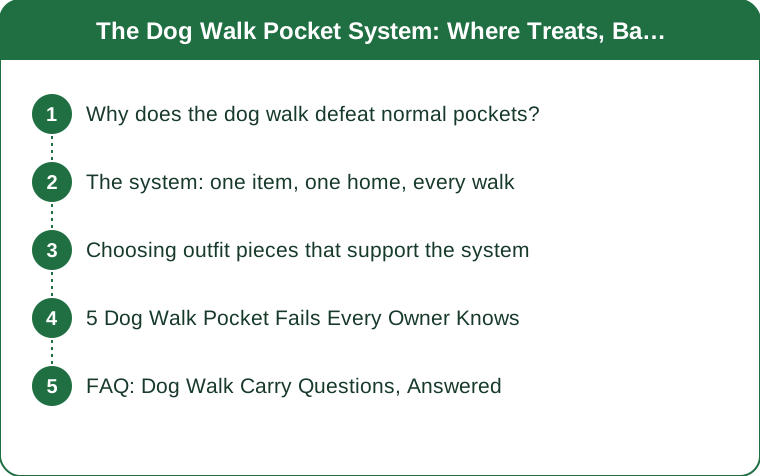
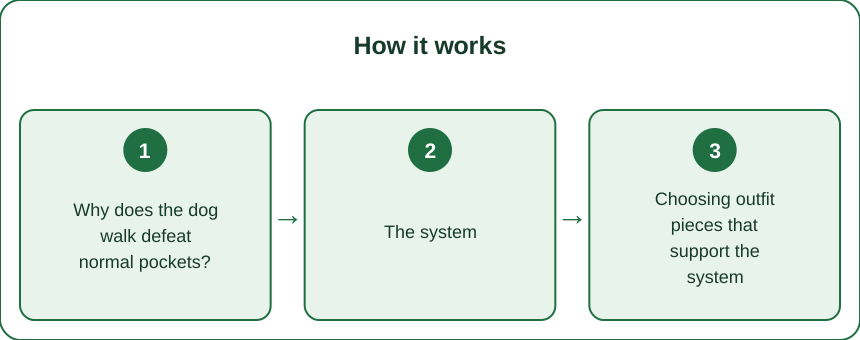
Why does the dog walk defeat normal pockets?
Four structural problems, none of which regular outfits were designed for.
One hand is always spoken for. The leash hand is permanently employed, which means every retrieval - phone, treat, bag - is a one-handed operation performed without full attention, often while walking. Pockets that need two hands (deep jacket pockets with zips at awkward angles, back pockets under a layer) functionally do not exist on a walk.
Timing is not negotiable. The treat has to arrive within a second or two of the good behavior, or the training moment is gone. The waste bag has to be there at the exact moment of need, not after a forty-second dig through a tote. Dog logistics are real-time logistics - and a system you have to think about is a system that fails under a reactive-dog moment when your whole brain is busy.
The cargo is hostile. Treats are greasy, crumbly, and fragrant - loose in a pocket, they stain fabric, perfume everything, and leave a crumb sediment that survives three washes. Used bags between trash cans are their own carriage problem. Keys scratch phone screens when they share a home. Half the system is simply keeping the cargo categories from touching each other.
And the walk involves actual movement. Bending for pickup duty, crouching for training, the occasional jog when the dog decides - shallow pockets dump their contents at exactly these moments. The phone that rode fine in a hoodie’s kangaroo pocket for a stroll exits that pocket the first time you bend over with a bag in hand.
The good news: this is a solved problem. Runners solved reachable-while-moving storage years ago, and the modern generation of pocketed leggings imported the solution. The rest is assignment - deciding, once, where each thing lives.
The system: one item, one home, every walk
Load out the same way every time, and by week two your hand finds everything without your eyes.
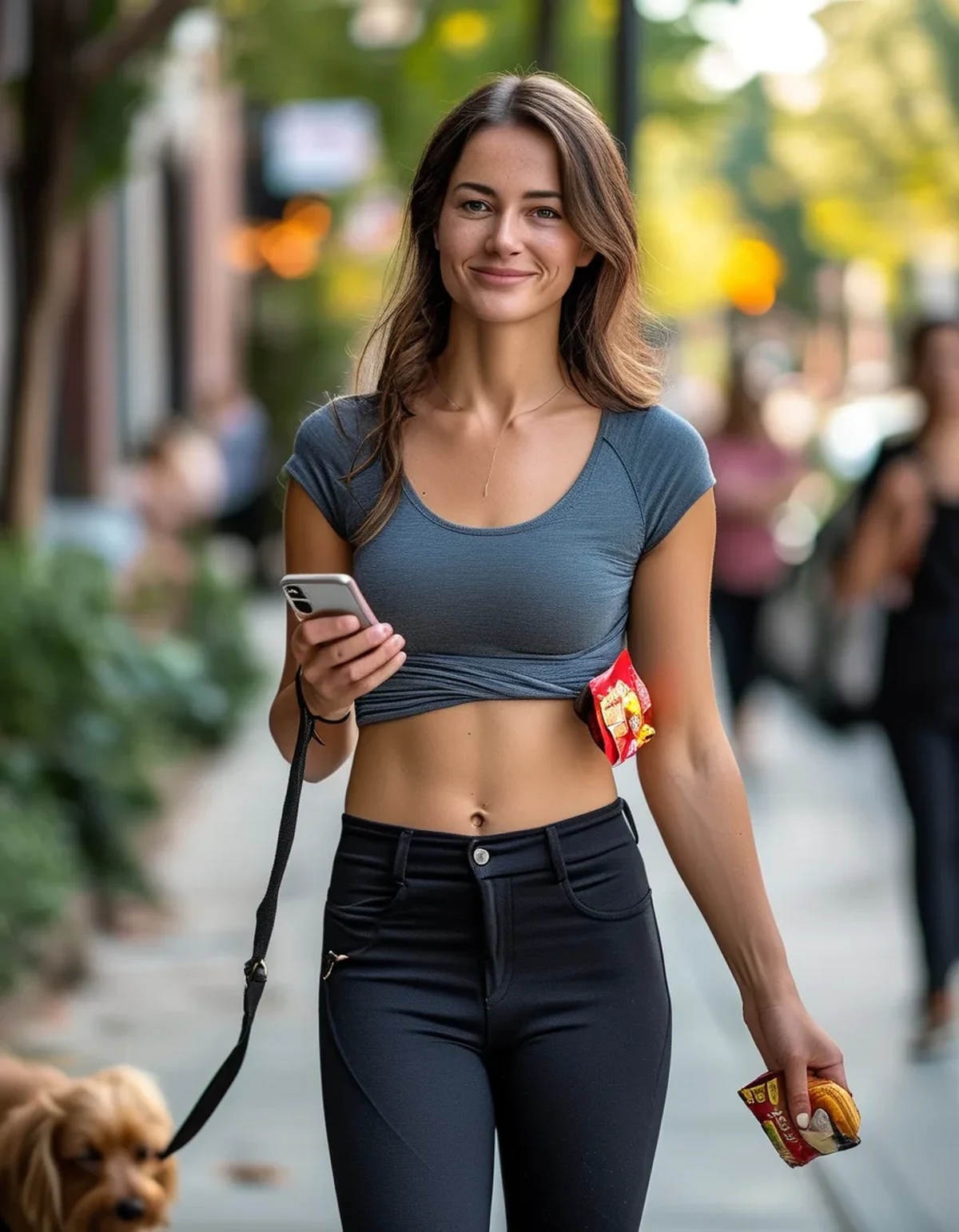
Phone: deep side thigh pocket, leash-opposite side. The side pocket on a good pair of high-waisted leggings holds a modern phone fully - the test is that the top edge sits at or below the pocket opening with no cantilever. Leash-opposite matters: the free hand does all retrieval, and cross-body reaches while a dog pulls are how phones meet pavement. If your current leggings have shallow pockets, the phone is exactly why the next pair should not.
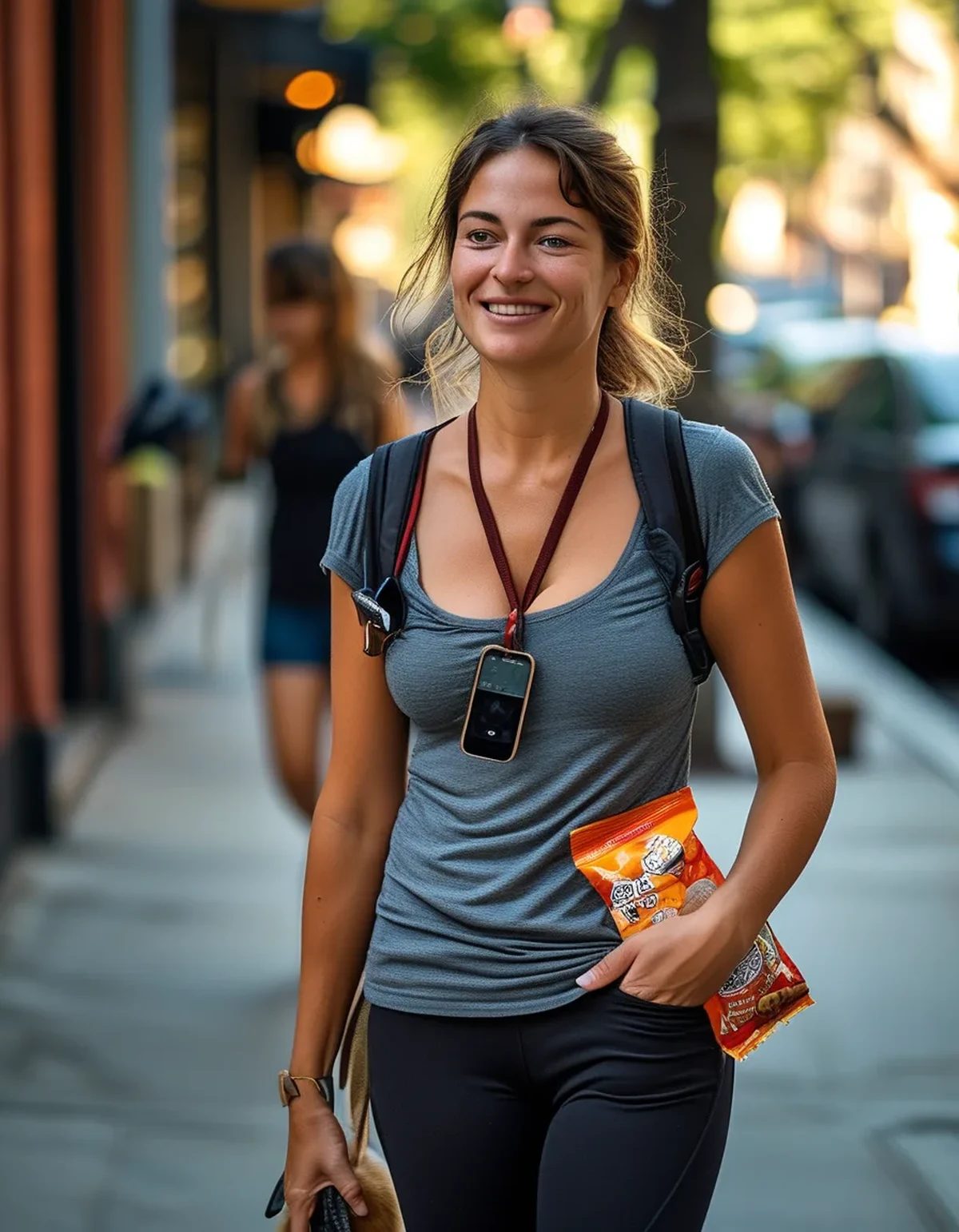
Treats: a dedicated home, never loose. Two workable options. Option one, the small clip-on treat pouch at the hip - fastest access, biggest capacity, washable, and it keeps grease out of your clothing entirely; this is the correct answer for training-heavy walks and puppy stages. Option two, for light-treat walks: one designated zip pocket - always the same one - lined with a snack-size zip bag you replace weekly. The liner trick converts any pocket into a treat pocket without sacrificing the garment. What is never correct: bare treats in a bare pocket. That pocket never fully recovers.
Waste bags: on the leash, not on you. A small bag dispenser clipped to the leash handle means the bags are present on every walk automatically, with zero morning decisions - and whoever holds the leash holds the bags, which matters in multi-walker households. Refill it when it runs low, the same way you refill anything. The backup: one flat-folded bag behind the phone in the side pocket, for the day the dispenser runs dry mid-walk.
Keys: clipped, not loose. A tiny carabiner or key clip attached inside a zip pocket - back waistband zip if you have one - ends the jingle, the screen scratches, and the did-I-drop-them pat-down. Take only the door key on walks if your keychain is a hardware store.
The carried-bag question: once the walk includes water, long-line gear, or more than one dog’s supplies, graduate honestly to a small crossbody or hip pack worn in front. The pocket system covers the daily neighborhood loop; the expedition gets luggage.
Choosing outfit pieces that support the system
The system only works if the clothes cooperate. What to look for, piece by piece:
Leggings: double side pockets plus a zip. The dog-walk ideal is high-waisted leggings with a deep side pocket on each thigh and one zip pocket - back waistband or in-pocket zip. Two side pockets means phone on one side and the liner-bagged treats or backup bags on the other, symmetrical and one-handed. The high waist matters functionally here: a band that stays planted through pickup bends keeps the pockets at a consistent address, while a rolling waistband relocates everything mid-walk. Squat-proof fabric earns its keep too - pickup duty is a squat test performed in public, several times a day.
Fabric: claw-rated and wash-ready. Between muddy paws, enthusiastic greetings, and the treat trade, dog-walk clothes get washed constantly and scraped regularly. Dense, smooth technical knits shrug off claws and clean easily; loose weaves and delicate loungewear snag and hold hair. Buttery-soft leggings feel wonderful but the thinnest versions pill under daily claw traffic - for the walk rotation, pick the heavier, tightly knit pairs and save the featherweights for the couch. Mid-tone colors with a little texture hide both dog hair and the morning’s smudges better than pure black or pale anything.
The top layer: one chest or hand-warmer pocket, zippable. In the cooler mornings that late August is starting to deliver, a light zip jacket or vest joins the walk - and its job in the system is the phone’s cold-weather home, high and zipped, where a bend cannot eject it. A hood that stays up in wind beats an umbrella that needs your nonexistent free hand.
Shoes: slip-on, weatherproof-ish, and committed. The walk happens twice a day regardless of conditions - a dedicated pair by the door, slip-on or elastic-laced, with enough tread for dewy grass, removes the last friction between you and out the door. They will not stay pretty. That is their entire career.
And everything machine-washable, no exceptions. Any piece that requires thought before washing exits the rotation by September on its own.
5 Dog Walk Pocket Fails Every Owner Knows
1. The eternal crumb lining. One week of loose treats and the pocket develops a permanent sediment layer - fragrant, greasy, discovered forever after by every hand you put in there. The zip-bag liner or the clip pouch exists because this fail is irreversible. Every dog owner has one jacket they quietly retired over it.
2. The squirrel-lunge phone launch. Phone resting in a shallow hoodie pocket, dog spots wildlife, leash arm yanks, phone describes a graceful arc onto the pavement. The deep side pocket with full containment is the fix - if any part of the phone rides above the pocket opening, the squirrel decides when it comes out.
3. The bare-hands realization. Mid-walk, dog assumes the position, hand goes to the usual spot - empty dispenser, no backup. The walk’s social contract hangs by a thread while you perform the universal pat-down of despair. The leash-mounted dispenser plus one flat bag behind the phone means this scene retires permanently.
4. The key jingle recall ruiner. Loose keys chiming with every step - mildly annoying to you, fascinating to a sound-sensitive dog, and the soundtrack that announces your pocket contents to the neighborhood. The clip ends it, and doubles as insurance the day you crouch on a slope and everything in that pocket tries to leave.
5. The two-jacket shell game. The system lived in Tuesday’s jacket; Wednesday you wore the other one. Now the bags, the spare key, and the emergency treat are all one garment away, discovered at the worst moment. The fix is boring and total: the system lives in the leggings and the leash, which go on every walk - jackets are guests, not infrastructure.
FAQ: Dog Walk Carry Questions, Answered
Are leggings pockets actually big enough for a modern phone?
The good ones, yes - deep side pockets on well-made pocketed leggings hold even large phones fully, which is the test to run in the fitting room: phone all the way in, then one squat and one toe-touch. If it peeks or levers out, the pocket is decorative and the pair is not walk equipment.
Treat pouch or pocket - which is better?
Pouch for training-heavy phases, puppies, and high-value greasy treats - faster access, zero garment damage, and it unclips when you get home. The lined-pocket method wins for light-treat maintenance walks when you want to carry nothing extra. Most owners end up using both, matched to the walk.
What fabric survives claws and daily washing best?
Dense, smooth technical knits - the tightly woven nylon-elastane family - resist snags and release hair and mud in a normal cold wash. Loose knits, waffles, and fleece grab claws and hold hair. Mid-tones with texture hide the evidence between washes better than black or cream.
Do I need reflective gear for evening walks yet?
Starting now, yes - sunsets are already creeping earlier, and by September the after-dinner walk finishes in dusk. A reflective strip on the leash, a small light on the collar, and one reflective detail on your jacket or shoes cover the household. Drivers see the lit dog before the dark human; light both.
TL;DR:
- One hand is always on the leash - every carried item needs a one-handed, no-look home.
- Phone deep in the leash-opposite side pocket; treats in a pouch or one lined sacrificial pocket, never loose.
- Waste bags clip to the leash so they attend every walk automatically; keys clip inside a zip pocket.
- Build the outfit on double-pocket high-waisted leggings, claw-tolerant fabric, and slip-on committed shoes.
- The system lives in the leggings and the leash, not the jacket - jackets rotate, infrastructure does not.
The dog brings the joy and the chaos in a fixed ratio. The pocket system cannot touch the ratio - it just makes sure the chaos never involves a shattered screen, a bagless emergency, or a pocket that smells like liver forever.
See It in Motion
Seen here: High Waist Yoga Leggings with Inner Pocket — shop it on bubblelime.com
Keep Reading
This article is for general informational and styling purposes only. Fit, sizing, and product availability may vary.